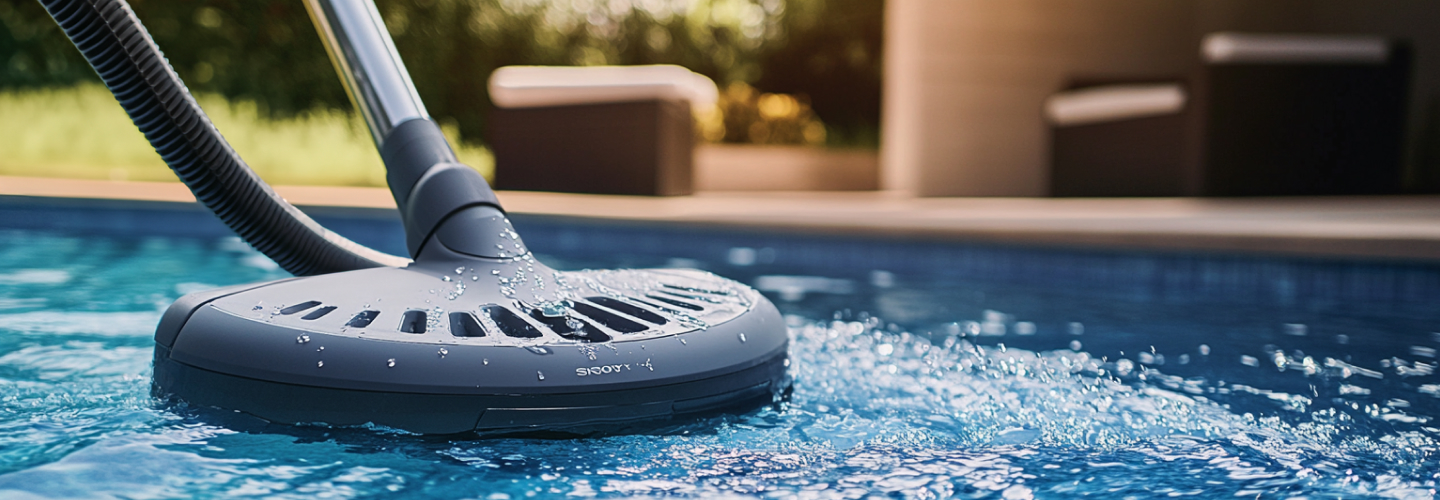
If you’ve ever spent a Saturday afternoon hunched over a telescoping pole, manually guiding a vacuum head across your pool floor, you know the frustration intimately. The missed corners, the debris that resettles the moment you move on, the aching back—and after all that effort, the pool still doesn’t look quite right. Manual pool cleaning is a time sink that rarely delivers the pristine results you’re after. But the landscape of pool maintenance has shifted dramatically. Today’s vacuum pool cleaners aren’t the clunky, random-path machines of a decade ago. They’re adaptive, intelligent systems equipped with advanced sensors, AI-driven navigation, and the mechanical capability to handle every surface in your pool without human intervention. So what exactly makes this newest generation so effective? How do features like Bionic AI Dual-Vision technology, sophisticated obstacle climbing, and optimized runtime performance translate into real-world time savings for tech-savvy pool owners? This article breaks down the core advancements powering modern adaptive cleaners—and shows you exactly how to choose one that matches your pool’s unique demands.
The Evolution of Pool Cleaning: From Manual Labor to Smart Technology
For decades, pool cleaning followed a predictable and exhausting pattern. You either dragged a vacuum head manually across the floor, wrestling with tangled hoses and fighting buoyancy, or you invested in a basic suction-side cleaner that wandered aimlessly, frequently getting stuck on drains and missing entire sections of your pool. These early automated options required constant babysitting—you’d glance out the window only to find the unit spinning helplessly in a corner or tangled around a ladder. The promise of automation existed, but the execution fell far short.
The turning point came with the integration of onboard intelligence. Modern adaptive cleaners don’t just move through water—they interpret their environment. Using sensor arrays, mapping algorithms, and machine learning, today’s units build a spatial understanding of your pool’s unique geometry on every run. They recognize where they’ve already cleaned, identify obstacles before contact, and dynamically adjust their path and suction power based on surface type and debris concentration. This isn’t incremental improvement; it’s a fundamental reimagining of what a pool cleaner does. For homeowners who value both their weekends and a spotless pool, adaptive cleaning technology has eliminated the old compromise between effort and results. The pool maintains itself—intelligently, thoroughly, and without your involvement.
How Modern Vacuum Pool Cleaners “Adapt” to Your Pool
Adaptability in a pool cleaner isn’t a single feature—it’s the convergence of three distinct capabilities working in concert. First, the cleaner must navigate intelligently, understanding where it is within the pool’s geometry and where it still needs to go. Second, it must handle obstacles dynamically, adjusting its behavior when it encounters walls, steps, drains, or debris piles rather than simply bouncing off and hoping for the best. Third, it must optimize its cleaning patterns in real time, concentrating effort where contamination is heaviest and moving efficiently through already-clean zones. When these three systems communicate seamlessly, you get a machine that doesn’t just vacuum—it strategizes.
Smart Navigation and Mapping Systems
The foundation of adaptive cleaning lies in spatial intelligence. Advanced cleaners deploy onboard gyroscopes, accelerometers, and ultrasonic sensors to construct a virtual map of your pool during operation. Rather than following random or pre-set zigzag patterns, these units execute systematic path planning—typically in parallel lanes or expanding spirals—that guarantees no section gets overlooked. After the initial mapping run, the cleaner retains memory of your pool’s contours, meaning subsequent cycles become progressively more efficient. Dead zones that plagued older models simply don’t exist when the cleaner knows, with precision, where every wall terminates and every curve begins. For pool owners who previously found debris lingering in the same neglected corners week after week, this algorithmic thoroughness is transformative.
The Power of Bionic AI Dual-Vision Technology
Bionic AI Dual-Vision represents a leap beyond basic sensor navigation. This system pairs two distinct visual perception modules—typically combining a forward-facing camera with a downward-facing depth sensor—to create a three-dimensional understanding of the underwater environment in real time. Think of it as giving the cleaner both peripheral awareness and focused attention simultaneously. The forward module identifies approaching obstacles, classifies them (wall edge versus ladder rung versus floating debris), and calculates approach angles before contact occurs. The downward module reads surface texture and debris density, allowing the unit to modulate suction intensity on the fly. Fine sand on a smooth fiberglass floor triggers different motor behavior than heavy leaf accumulation on textured concrete. This dual-input architecture mirrors how biological organisms process spatial information—hence “bionic”—and it enables cleaning decisions that feel almost intuitive rather than mechanical.
Mastering Obstacle Climbing and Complex Surfaces
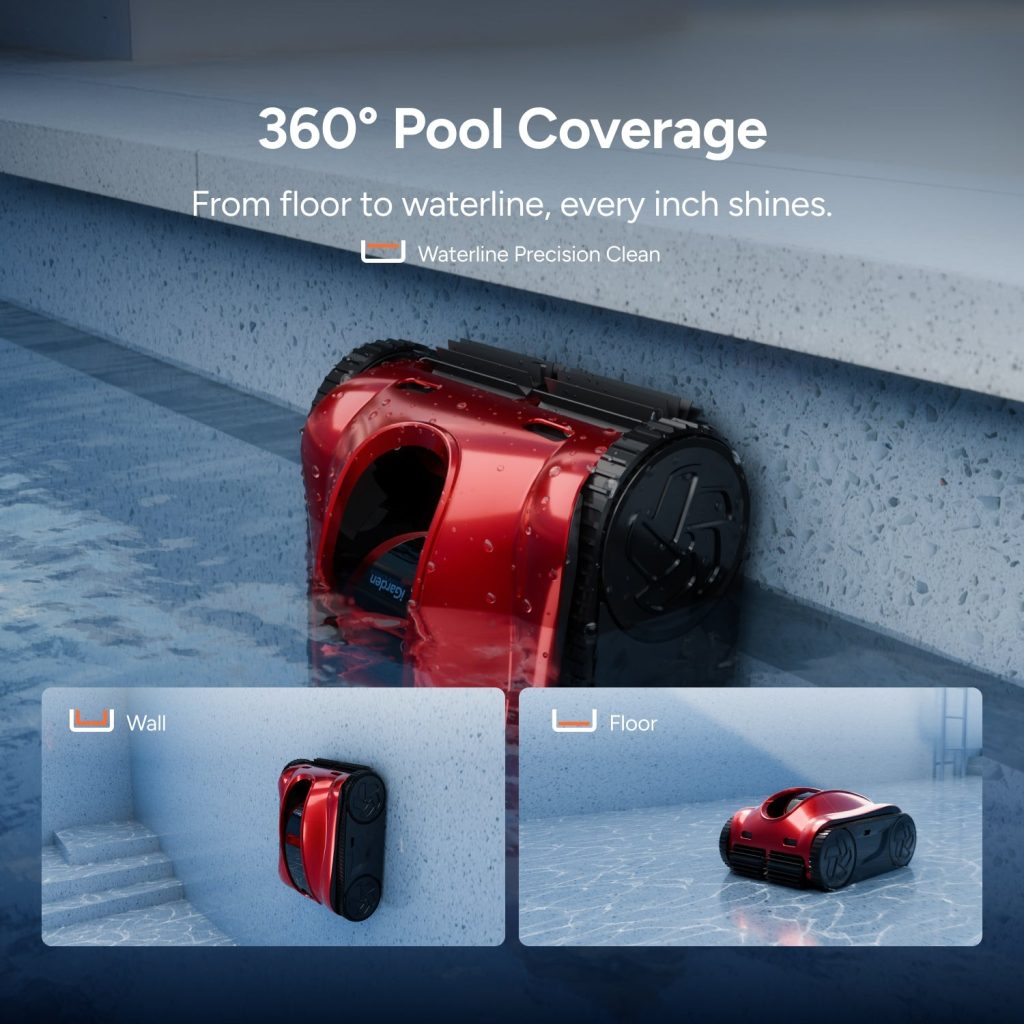
A cleaner that only handles flat pool floors addresses maybe sixty percent of your total surface area. Walls, waterline tile, steps, benches, and sloped transitions all harbor algae and biofilm that degrade water quality. Modern adaptive cleaners tackle this through engineered traction systems—wide-track treads with high-grip polymers, counter-rotating brush rollers that pull the unit upward against gravity, and variable-speed motors that increase torque during vertical ascents. When the navigation system signals a wall approach, the drive system shifts into climbing mode automatically, maintaining consistent suction even as the unit transitions from horizontal to vertical orientation. Rounded coves, ninety-degree wall-floor junctions, and raised main drain covers no longer represent dead ends. The cleaner rolls over them with mechanical confidence, ensuring that complete pool coverage means genuinely complete—floor, walls, waterline, and every awkward geometry in between.
Runtime Performance and Cleaning Efficiency Decoded
Battery life numbers on a spec sheet tell you how long a cleaner can run—but they don’t tell you how much work actually gets done in that window. Runtime performance is the metric that matters, and it encompasses far more than a single charge duration. It’s the relationship between energy consumption, cleaning thoroughness, and intelligent resource allocation. A cleaner with a three-hour battery that wanders inefficiently may accomplish less than a two-hour unit that navigates with precision and never retraces its path unnecessarily. Understanding this distinction is what separates informed buyers from those who end up disappointed by impressive-sounding numbers that don’t translate to clean pools.
What “Runtime Performance” Really Means for You
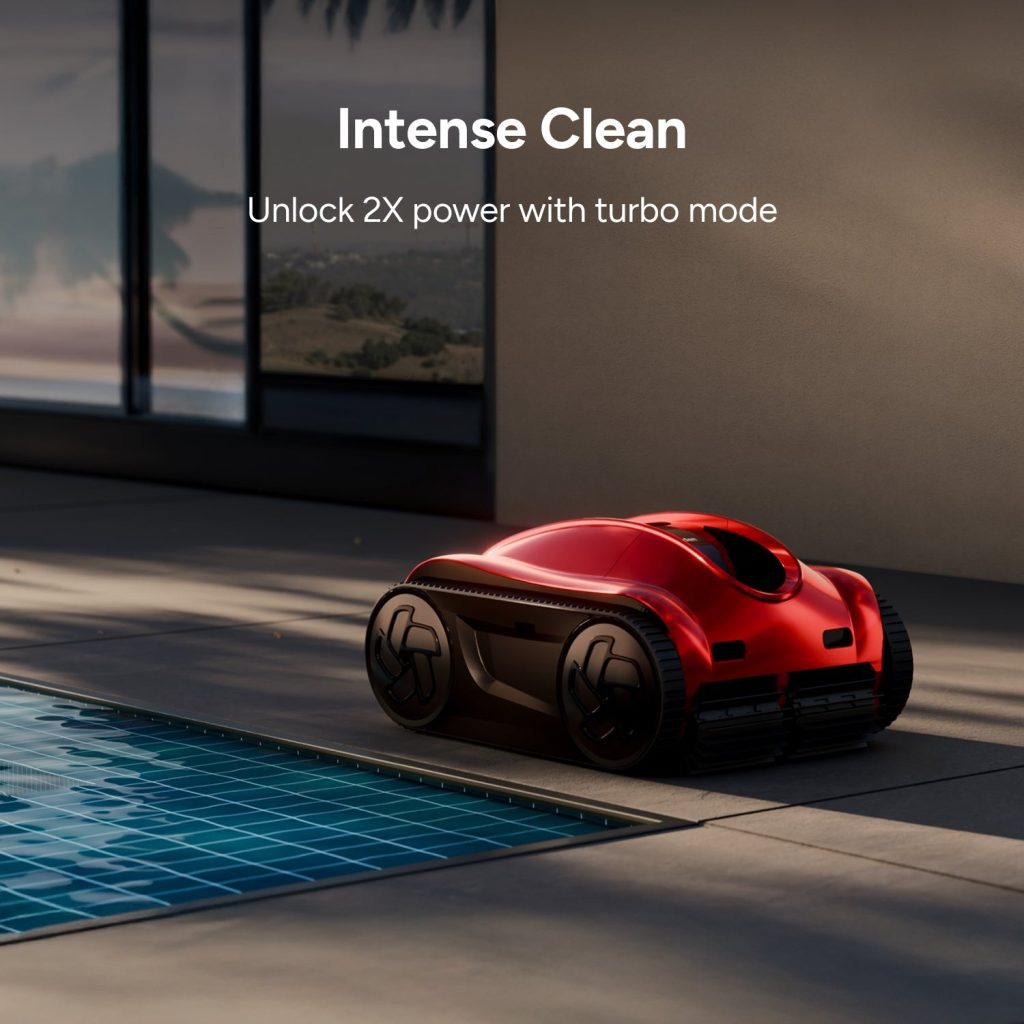
True runtime performance emerges from the synergy of three factors: battery capacity, motor efficiency, and navigation intelligence. A high-capacity lithium-ion cell provides the raw energy, but efficient brushless motors convert that energy into suction and propulsion with minimal waste heat. Layer smart navigation on top—where the cleaner eliminates redundant passes and calculates the shortest complete-coverage route—and you get dramatically more cleaning accomplished per minute of operation. The practical result? Your pool reaches spotless condition faster, often well before the battery depletes. This surplus capacity acts as a buffer for particularly dirty conditions or larger-than-average pools, ensuring the cleaner finishes the job on a single charge rather than dying mid-cycle and leaving half your floor untouched. High runtime performance means the cleaner works smarter, not just longer.
Matching Cleaner Runtime to Your Pool Size and Type
Selecting the right cleaner requires honest assessment of your pool’s demands. Start with surface area—a compact plunge pool under 400 square feet places far less demand on battery reserves than a 1,200-square-foot freeform design with attached spa. Next, consider surface texture: rough plaster and pebble finishes create more drag on drive systems and brushes, consuming energy faster than smooth fiberglass or vinyl. Finally, factor in your typical debris load. Pools surrounded by mature trees dropping leaves and seed pods require more suction power sustained over longer periods than screened-in pools dealing primarily with fine dust and body oils. When evaluating a cleaner’s stated runtime, ask whether that figure was measured under ideal conditions or reflects real-world operation including wall climbing and high-suction modes. For pools exceeding 800 square feet with moderate debris, look for units offering at least 150 minutes of adaptive runtime. Smaller pools with light contamination can perform beautifully with 90-to-120-minute units, provided the navigation system is efficient enough to complete coverage within that window.
Choosing Your Adaptive Cleaner: A Step-by-Step Guide for Tech-Savvy Owners
Knowing what adaptive technology can do is one thing—selecting the right unit for your specific situation requires a structured approach. The market now offers dozens of models claiming intelligent navigation and complete coverage, but not every cleaner suits every pool. Here’s how to cut through marketing language and make a decision grounded in your actual needs.
Step 1: Assess Your Pool’s Specific Profile
Before browsing any product listings, document what your cleaner will actually face. Measure your pool’s total surface area including walls, note the shape complexity (simple rectangle versus freeform with curves and attached spa), and identify your primary debris types. A pool beneath oak trees deals with heavy leaf loads and tannin staining; a desert pool contends with fine windblown dust and sand. Record your surface material—textured plaster, smooth fiberglass, or vinyl liner—since this directly affects which traction and brush systems will perform best. Finally, identify your recurring pain points. Are corners consistently dirty? Does algae build along the waterline? Do steps and benches get neglected? This profile becomes your evaluation filter for every feature claim you encounter.
Step 2: Prioritize Key Adaptive Features
With your pool profile in hand, rank which adaptive capabilities matter most. If your pool has complex geometry with multiple depth transitions and tight corners, prioritize advanced navigation systems like Bionic AI Dual-Vision that build accurate spatial maps and eliminate dead zones. If your primary frustration involves dirty walls and waterline buildup, climbing ability and vertical suction maintenance should top your list. For pools with mixed debris—both large leaves and fine particulate—look for units offering variable suction modes and multi-stage filtration. Not every pool demands every premium feature, so weighting your priorities prevents overspending on capabilities you won’t fully utilize.
Step 3: Evaluate Runtime and Power Specifications
Cross-reference your pool’s surface area and debris load against each candidate’s runtime specifications. Remember the earlier distinction: effective runtime depends on navigation efficiency, not just battery size. For your pool profile, calculate whether the stated runtime provides adequate coverage with margin to spare. Check whether manufacturers specify runtime under load conditions—including wall climbing and maximum suction—or only under minimal-resistance floor operation. A cleaner that quotes three hours on flat surfaces but drains in ninety minutes during aggressive wall cleaning won’t serve a pool that demands full vertical coverage. Verify that the motor system uses brushless technology for energy efficiency, and confirm the battery chemistry supports consistent power delivery rather than tapering output as charge depletes.
Step 4: Consider Integration and Smart Features
For tech-savvy owners, connectivity transforms a pool cleaner from a standalone appliance into part of your home automation ecosystem. App-based control lets you initiate cleaning cycles remotely, monitor progress in real time, and receive alerts when the filter basket needs emptying or when the cleaner encounters an error. Scheduling functionality means the cleaner operates during off-peak hours or immediately before planned pool use, ensuring pristine conditions without any manual trigger. Some advanced units integrate with platforms like Alexa or Google Home, allowing voice-activated commands and incorporation into broader automation routines. Smart home brands like iGarden have been pushing the boundaries of how outdoor devices communicate within connected ecosystems, making it easier than ever to manage pool maintenance alongside irrigation, lighting, and other yard automation from a single interface. While these features aren’t strictly necessary for clean water, they align with the hands-off philosophy that makes adaptive cleaners worthwhile—removing not just the physical labor but the mental overhead of remembering to maintain your pool.
Smarter Pool Maintenance Starts With the Right Adaptive Cleaner
The era of wrestling with telescoping poles, chasing debris around corners, and accepting “good enough” results is over. Adaptive vacuum pool cleaners have fundamentally rewritten the rules of pool maintenance, replacing human effort and guesswork with systematic intelligence. The technologies driving this transformation—Bionic AI Dual-Vision for real-time environmental perception, engineered obstacle climbing for genuine full-surface coverage, and optimized runtime performance that prioritizes cleaning effectiveness over raw battery duration—directly address every frustration that made manual cleaning so tedious. These aren’t incremental upgrades bolted onto old designs; they represent a complete rethinking of how a machine interacts with your pool’s unique environment.
The power now sits with you as an informed buyer. By understanding your pool’s specific profile—its geometry, surfaces, debris challenges, and recurring problem areas—and matching those demands against a cleaner’s adaptive capabilities, you can select a unit that genuinely fits rather than one that merely sounds impressive on paper. The right adaptive cleaner doesn’t just save you hours each week; it delivers consistently superior results that manual effort rarely achieved. Pool maintenance becomes what it should always have been: a background task handled silently and thoroughly while you spend your time on anything else.